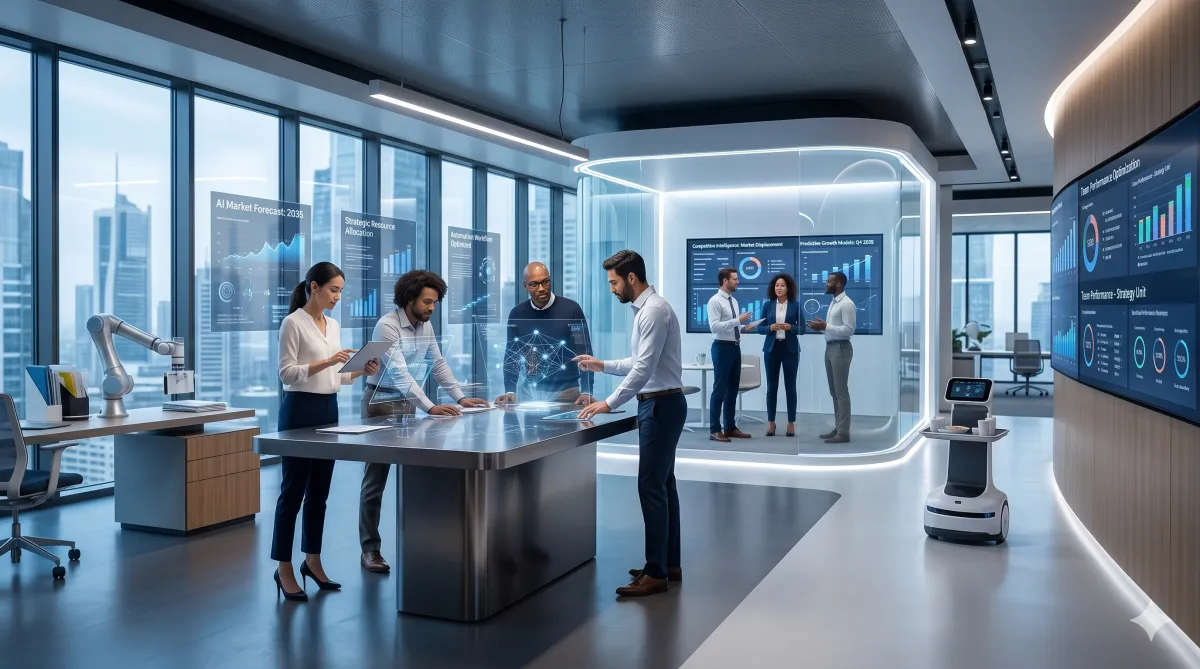
The Workforce of 2035 Will Be Smaller, Faster, and Far More Strategic
The Size of the Workforce Is Not the Right Metric Anymore
For decades, growth was measured by:
headcount
team size
organizational expansion
More people meant more capacity.
But that equation is breaking.
Because in the next decade, performance won’t scale with size—it will scale with capability.
The Shift: From Volume to Capability Density
In the future, organizations will prioritize:
• fewer people with higher impact
• broader skill sets per individual
• stronger decision-making capability
• faster execution across teams
• reduced dependency on layers of management
This is what defines capability density.
And it will become the new competitive advantage.
Why the Workforce Will Get Smaller
AI and automation will:
• eliminate repetitive tasks
• reduce administrative overhead
• streamline coordination
• accelerate execution
This doesn’t mean organizations won’t grow.
It means they won’t need to grow headcount at the same rate.
The result:
Smaller teams.
Higher expectations.
Greater individual responsibility.
Why the Workforce Will Get Faster
Speed will become a defining factor.
Organizations will need to:
• make decisions quickly
• adapt to change rapidly
• respond to market shifts in real time
• execute without excessive layers
That requires:
• decentralized decision-making
• clearer priorities
• stronger alignment across teams
• leaders who can operate under pressure
Slow organizations will not compete.
Why the Workforce Must Become More Strategic
As AI handles more execution, human value shifts toward:
• judgment
• prioritization
• strategic thinking
• problem-solving
• leadership
Employees won’t just be expected to:
complete tasks
They’ll be expected to:
understand impact
make decisions
drive outcomes
That’s a fundamental change in expectations.
The End of Traditional Career Pathways
The future workforce won’t follow linear progression.
You won’t see:
clear step-by-step promotions
predictable role transitions
time-based advancement
Instead, careers will be shaped by:
• capability development
• visibility of impact
• ability to operate at higher levels
• adaptability across roles
Progression becomes less structured—and more earned.
What This Means for Organizations
Leaders must rethink:
• how teams are structured
• how roles are defined
• how performance is measured
• how leadership is developed
• how talent is retained
Because a workforce designed for stability
cannot operate in a system defined by speed and change.
The Risk of Not Adapting
Organizations that don’t evolve will face:
• bloated structures with low efficiency
• slow decision-making
• misaligned talent
• weak leadership pipelines
• inability to scale effectively
• loss of competitive positioning
And the gap will widen quickly.
What Forward-Thinking Organizations Are Building
They are focusing on:
• capability-based workforce planning
• leadership development at all levels
• streamlined organizational structures
• faster decision-making systems
• continuous learning environments
• alignment between strategy and execution
They’re not preparing for incremental change.
They’re preparing for a different operating model.
The Professional Reality
If you’re relying on:
your role
your title
your tenure
You’re exposed.
The future belongs to those who:
• think strategically
• make decisions confidently
• adapt quickly
• operate across boundaries
• create visible impact
Because in a smaller workforce,
average performance won’t be enough.
The Hard Truth
In the future, organizations won’t need more people.
They’ll need more capable people.
The Question Leaders Must Ask
Not:
“How do we grow our workforce?”
But:
“How do we increase the capability and impact of the workforce we have?”
Because the organizations that win won’t be the biggest.
They’ll be the most effective.
Ready to Strengthen Your Workforce Strategy?
Today’s HR leaders are being asked to do more than ever before—retain talent, improve culture, develop leaders, manage change, and prepare for the impact of AI.
You do not have to figure it all out alone.
BBRCM helps organizations build stronger leadership, smarter workforce strategies, healthier cultures, and HR systems that are ready for the future.
Visit BBRCM LLC’s HR page to learn more: https://bbrcmllc.com/hr
Or email [email protected] to start the conversation.
