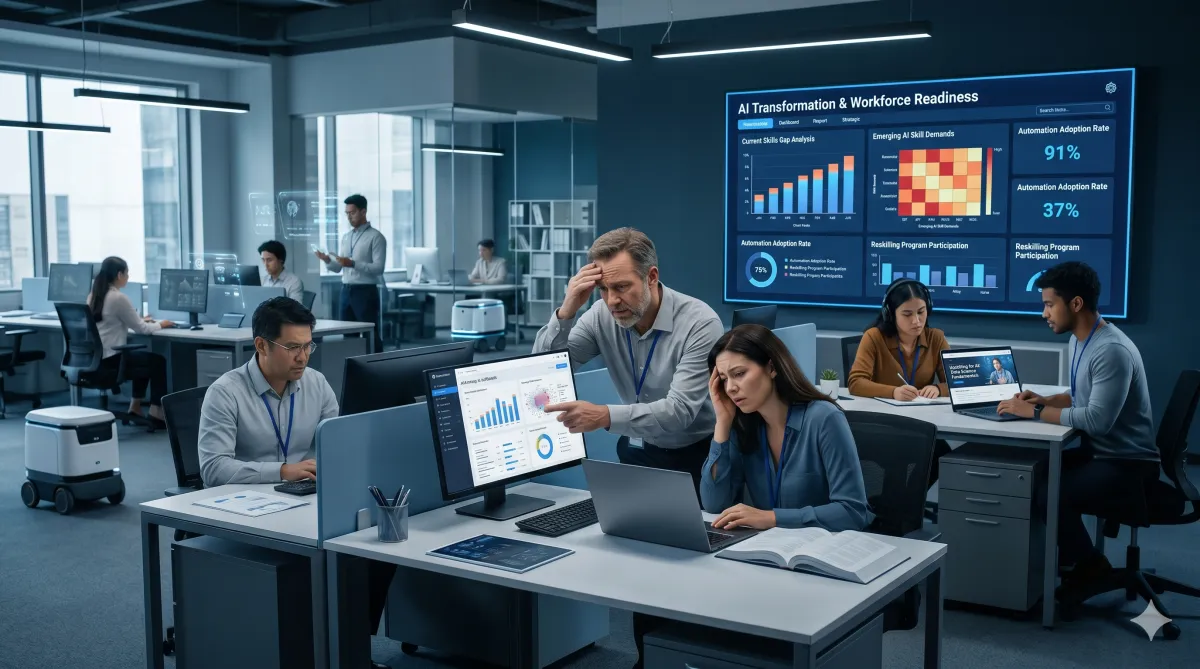
The Skills Crisis No One Is Talking About in the Age of AI
Everyone Is Talking About the Wrong Skills Gap
Organizations are investing heavily in:
AI tools
data platforms
automation systems
technical upskilling
And while those matter, they’re not the real issue.
The actual skills crisis is not technical.
It’s behavioral.
The Skills That Are Actually Missing
Across organizations, leaders are seeing gaps in:
• decision-making under uncertainty
• critical thinking
• prioritization
• communication clarity
• cross-functional alignment
• accountability
• adaptability under pressure
These aren’t new skills.
But they’re becoming more important—and more visible—because of AI.
Why AI Is Exposing This Gap
AI is accelerating:
• access to information
• speed of execution
• volume of data
• decision complexity
Which means employees must now:
• interpret more information
• make faster decisions
• manage ambiguity
• validate outputs
• connect insights across functions
Technical tools increase capability.
But they also increase the demand for judgment.
The Illusion of “Upskilling”
Many organizations believe they’re solving the problem through:
• technical training programs
• certifications
• platform adoption
• tool onboarding
But these efforts often miss the core issue.
Because knowing how to use a tool
is not the same as knowing how to think.
The New Capability Divide
The workforce is splitting into two groups:
1. Tool Operators
• follow systems
• execute tasks
• rely on outputs
• operate within defined processes
2. Strategic Thinkers
• interpret information
• make decisions
• challenge assumptions
• connect insights to outcomes
AI reduces the value of the first group.
It increases the value of the second.
Why This Is Becoming a Business Risk
Without strong behavioral capability, organizations will see:
• faster execution—but poorer decisions
• increased reliance on flawed outputs
• inconsistent performance across teams
• weak leadership pipelines
• reduced adaptability to change
• higher error rates in complex situations
This doesn’t look like a skills gap.
It looks like instability.
The Leadership Blind Spot
Leaders often ask:
“What tools should we invest in?”
Instead of:
“What capabilities do our people need to operate effectively with these tools?”
That gap creates imbalance.
Technology advances.
Capability lags.
Performance becomes unpredictable.
What High-Performance Organizations Are Doing
They are shifting focus from technical skills to behavioral capability.
They invest in:
• decision-making frameworks
• critical thinking development
• leadership capability across levels
• communication clarity
• accountability systems
• real-world problem-solving
They understand:
Tools amplify performance.
But people determine direction.
The Professional Reality
If you’re focusing only on technical skills, you’re limiting your long-term value.
Because tools change quickly.
Capabilities endure.
To stay relevant, develop:
• how you think
• how you decide
• how you communicate
• how you adapt
• how you lead—even without authority
That’s what AI cannot replace.
The Hard Truth
The biggest risk is not that employees won’t learn new tools.
It’s that they won’t develop the thinking required to use them effectively.
The Question Leaders Must Ask
Not:
“What skills do we need to teach?”
But:
“What capabilities do we need to build?”
Because the organizations that succeed won’t just have smarter tools.
They’ll have smarter decision-makers.
Ready to Strengthen Your Workforce Strategy?
Today’s HR leaders are being asked to do more than ever before—retain talent, improve culture, develop leaders, manage change, and prepare for the impact of AI.
You do not have to figure it all out alone.
BBRCM helps organizations build stronger leadership, smarter workforce strategies, healthier cultures, and HR systems that are ready for the future.
Visit BBRCM LLC’s HR page to learn more: https://bbrcmllc.com/hr
Or email [email protected] to start the conversation.
