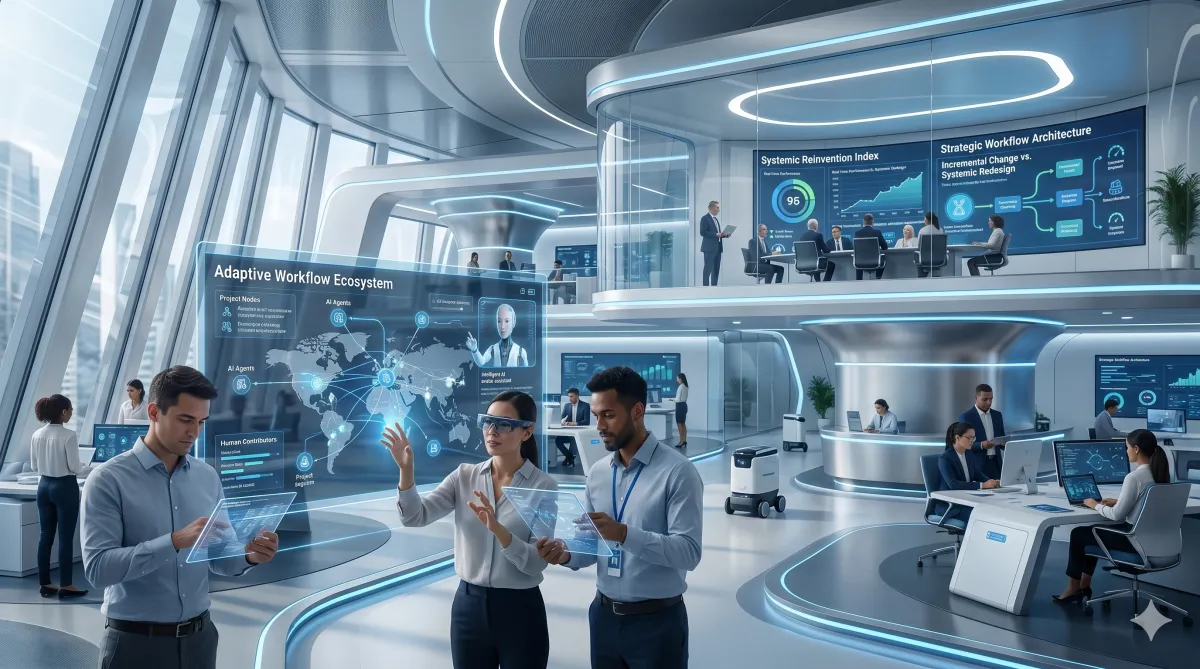
The Organizations That Thrive in the AI Era Will Redesign Work—Not Just Jobs
Most Organizations Are Applying AI to the Wrong Problem
Right now, many companies are using AI to:
automate tasks
increase efficiency
reduce costs
speed up processes
All useful.
But limited.
Because they’re applying AI to existing structures instead of questioning whether those structures still make sense.
The Real Opportunity Isn’t Automation—It’s Redesign
Most work today is organized around:
• fixed roles
• defined responsibilities
• linear workflows
• functional silos
• layered decision-making
These structures were built for a slower, more predictable environment.
AI changes that.
And when the environment changes, the structure must change with it.
What “Redesigning Work” Actually Means
It means stepping back and asking:
• What work truly requires human input?
• What can be automated or augmented?
• How should tasks be grouped for maximum efficiency?
• Where are we creating unnecessary friction?
• How can decisions be made faster and closer to execution?
Instead of:
“How do we improve this process?”
The question becomes:
“Should this process exist in its current form at all?”
The Shift From Jobs to Work Systems
Traditional model:
Jobs → Tasks → Output
Future model:
Work systems → Capabilities → Outcomes
This shift allows organizations to:
• move faster
• reduce inefficiencies
• adapt more easily
• align work with strategy
• scale without adding unnecessary complexity
Why Redesign Is Hard
Because it challenges:
• existing roles
• established hierarchies
• comfort zones
• leadership habits
• traditional career paths
It requires:
rethinking structure
redefining responsibility
redistributing decision-making
That’s uncomfortable.
So most organizations avoid it.
The Risk of Not Redesigning
If organizations only automate existing work, they’ll see:
• temporary efficiency gains
• but persistent structural inefficiencies
• faster execution of outdated processes
• continued misalignment across teams
• limited scalability
• growing complexity over time
They’ll improve speed—but not performance.
What High-Performance Organizations Are Doing
They are:
• breaking work into components—not roles
• redesigning workflows around AI + human collaboration
• removing unnecessary layers of decision-making
• aligning work directly with outcomes
• building flexible structures instead of rigid roles
• enabling faster, cross-functional execution
They don’t optimize the old system.
They replace it.
The Leadership Shift
Leaders must move from:
managing people
overseeing tasks
maintaining structure
To:
• designing systems
• enabling performance
• removing friction
• accelerating decision-making
• aligning execution with strategy
Leadership becomes less about control—and more about design.
The Workforce Implication
Employees are no longer defined by:
their role
their title
their task list
They are defined by:
• the value they create
• the problems they solve
• the decisions they make
• their ability to adapt
• their contribution to outcomes
That’s a higher standard.
But also a greater opportunity.
The Professional Reality
If you’re operating strictly within your role, you’re limiting your relevance.
The future belongs to those who:
• understand how work flows across the organization
• contribute beyond defined responsibilities
• think in terms of outcomes—not tasks
• adapt to changing structures
• collaborate across boundaries
Because work is changing faster than roles can keep up.
The Hard Truth
AI will not just improve how work is done.
It will force organizations to question why work is structured the way it is.
The Question Leaders Must Ask
Not:
“How can we use AI to improve what we do?”
But:
“If we were starting today, how would we design this work from the ground up?”
Because the organizations that win in the AI era won’t just be more efficient.
They’ll be fundamentally different.
Ready to Strengthen Your Workforce Strategy?
Today’s HR leaders are being asked to do more than ever before—retain talent, improve culture, develop leaders, manage change, and prepare for the impact of AI.
You do not have to figure it all out alone.
BBRCM helps organizations build stronger leadership, smarter workforce strategies, healthier cultures, and HR systems that are ready for the future.
Visit BBRCM LLC’s HR page to learn more: https://bbrcmllc.com/hr
Or email [email protected] to start the conversation.
