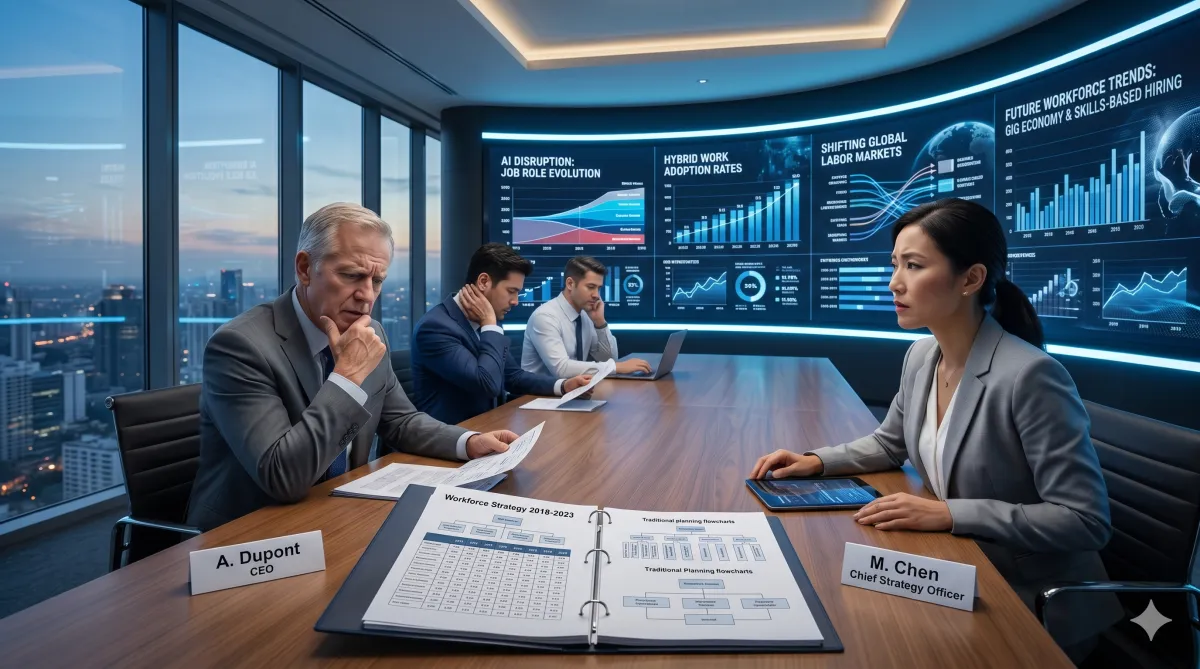
Your Workforce Strategy Is Probably Built for a World That No Longer Exists
Most Workforce Strategies Are Quietly Outdated
On paper, many organizations look aligned.
Roles are defined.
Teams are structured.
Hiring plans are in place.
Performance systems are running.
But underneath, there’s a disconnect.
Because most workforce strategies were designed for:
• stable roles
• predictable demand
• linear career paths
• centralized work environments
• slower change cycles
That world is gone.
The Environment Changed—But the Structure Didn’t
Today’s reality looks different:
• AI is reshaping tasks within roles
• remote and hybrid work are permanent
• skills are becoming obsolete faster
• decision-making needs to be faster and more distributed
• work is becoming more cross-functional
• business models are evolving rapidly
But many organizations are still operating with:
yesterday’s structures
yesterday’s assumptions
yesterday’s workforce models
That gap creates friction everywhere.
What an Outdated Workforce Strategy Looks Like
You’ll see:
• rigid job descriptions in flexible environments
• hiring for roles instead of capabilities
• slow internal mobility
• overdependence on specific individuals
• unclear ownership across teams
• misalignment between strategy and talent
• reactive hiring instead of proactive planning
It feels like the organization is working hard.
But not moving efficiently.
The Real Shift: From Roles to Capabilities
Traditional workforce strategy asks:
“Who do we need to hire?”
Future-ready workforce strategy asks:
“What capabilities do we need to build?”
That’s a fundamental shift.
Because roles can change.
Capabilities endure.
AI Is Accelerating the Breakdown of Role-Based Thinking
AI doesn’t replace entire jobs.
It replaces:
tasks
processes
components of roles
Which means:
• roles are becoming fluid
• responsibilities are shifting
• skill requirements are evolving continuously
If your workforce strategy is based on static roles,
it will fall behind quickly.
Why This Matters for Organizational Performance
When workforce strategy is outdated, you get:
• slower execution
• duplicated effort
• misaligned priorities
• talent gaps in critical areas
• underutilized employees
• increased dependency on a few key people
And leaders often misdiagnose it as:
performance issues
communication problems
engagement challenges
When the real issue is structural.
What Forward-Looking Organizations Are Doing
They are redesigning workforce strategy around:
Capability Mapping
• identifying current vs future skill needs
• aligning talent with strategic direction
Flexible Role Design
• allowing roles to evolve
• reducing rigid job boundaries
Internal Mobility Systems
• moving talent across functions
• redeploying capability quickly
AI Integration
• redesigning work around human + AI collaboration
• optimizing tasks, not just roles
Decentralized Decision-Making
• empowering teams to act faster
• reducing bottlenecks
They’re not adjusting the old model.
They’re replacing it.
The Leadership Challenge
Leaders must rethink:
• how roles are defined
• how talent is deployed
• how work is structured
• how performance is measured
• how quickly the organization can adapt
Because workforce strategy is no longer static.
It’s dynamic.
The Professional Reality
If you’re relying on a fixed role to define your career, you’re exposed.
The people who thrive will:
• build adaptable skill sets
• operate across functions
• understand how their work connects to strategy
• stay aligned with evolving capability needs
Because roles may change.
But value must remain.
The Hard Truth
You can’t execute a modern strategy
with an outdated workforce model.
The Question Leaders Must Ask
Not:
“Do we have the right people?”
But:
“Do we have the right capabilities, structured the right way, for where we’re going?”
Because if your workforce strategy is built for the past,
your future performance is already at risk.
Ready to Strengthen Your Workforce Strategy?
Today’s HR leaders are being asked to do more than ever before—retain talent, improve culture, develop leaders, manage change, and prepare for the impact of AI.
You do not have to figure it all out alone.
BBRCM helps organizations build stronger leadership, smarter workforce strategies, healthier cultures, and HR systems that are ready for the future.
Visit BBRCM LLC’s HR page to learn more: https://bbrcmllc.com/hr
Or email [email protected] to start the conversation.
