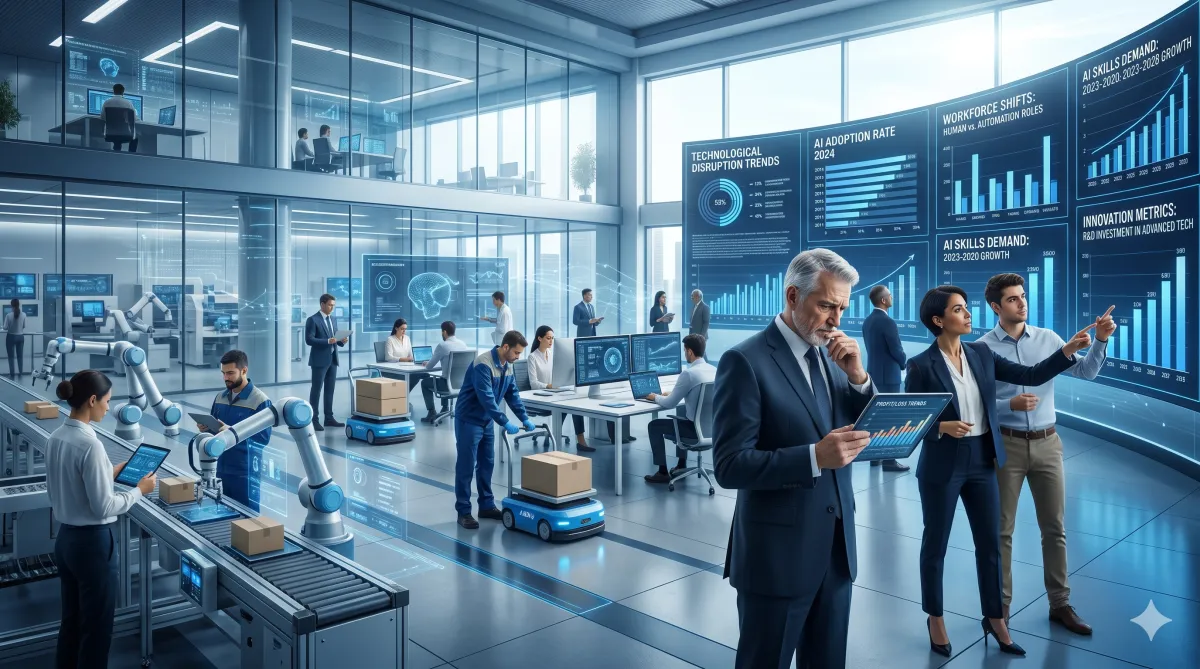
The Next Workforce Disruption Won’t Be Economic—It Will Be Technological
Most Leaders Are Preparing for the Wrong Disruption
Organizations are used to navigating:
economic downturns
market fluctuations
industry cycles
budget constraints
These disruptions are familiar.
They’re expected.
They’re modeled.
They’re managed.
But the next major disruption won’t follow that pattern.
It won’t be gradual.
It won’t be predictable.
And it won’t be driven by the economy.
It Will Be Driven by Technology
AI is not just another tool.
It is fundamentally changing:
• how work is executed
• how decisions are made
• how quickly organizations must respond
• how value is created
• how teams are structured
This isn’t a cycle.
It’s a structural shift.
Why This Disruption Is Different
Economic disruptions affect:
demand
spending
growth rates
Technological disruption affects:
capability
speed
structure
competition
That means:
The organizations that adapt faster gain immediate advantage.
The ones that don’t fall behind quickly—and visibly.
The Risk of Treating AI Like a Tool
Many organizations are approaching AI like previous technologies:
“We’ll integrate it gradually.”
“We’ll test it in certain areas.”
“We’ll adopt it where it fits.”
That mindset is dangerous.
Because AI doesn’t just improve parts of the business.
It changes the entire system.
What Happens When Organizations Underestimate the Shift
They experience:
• faster competitors entering the market
• reduced cost advantages
• outdated workforce capabilities
• slower decision-making
• inability to scale efficiently
• loss of top talent to more advanced environments
And they don’t always see it coming.
Because the shift feels incremental—until it isn’t.
The Real Impact: Speed and Capability
AI creates two major advantages:
1. Speed
• faster execution
• faster decision-making
• faster adaptation
2. Capability
• better data interpretation
• improved problem-solving
• enhanced productivity
Organizations that combine both outperform quickly.
Those that don’t struggle to keep up.
The Workforce Implication
This disruption is not just about systems.
It’s about people.
Organizations must rethink:
• what skills are needed
• how roles are structured
• how teams collaborate
• how decisions are made
• how leadership operates
Because a workforce designed for a slower world
cannot compete in a faster one.
What Forward-Thinking Organizations Are Doing
They are not waiting.
They are:
• redesigning workflows around AI integration
• investing in workforce capability—not just tools
• accelerating decision-making structures
• building adaptability into teams
• aligning leadership with technological change
• treating AI as a transformation—not an upgrade
They understand:
The advantage is not in adopting AI.
It’s in adapting the organization around it.
The Leadership Reality
Leaders must shift from asking:
“How can AI help us?”
To asking:
“How must we change because of AI?”
That includes:
• strategy
• structure
• workforce
• leadership behavior
• performance systems
Because partial change won’t be enough.
The Professional Insight
For individuals, this means:
Job security is no longer tied to stability.
It’s tied to adaptability.
The people who will stay relevant are those who:
• learn continuously
• adapt quickly
• think strategically
• operate beyond their defined role
• understand how technology impacts their work
Because disruption doesn’t wait for readiness.
The Hard Truth
The next disruption is already happening.
Most organizations just haven’t fully recognized it yet.
The Question Leaders Must Ask
Not:
“How do we adopt AI?”
But:
“How do we redesign our organization to compete in an AI-driven world?”
Because the companies that win won’t just use better tools.
They’ll operate at a different level entirely.
Ready to Strengthen Your Workforce Strategy?
Today’s HR leaders are being asked to do more than ever before—retain talent, improve culture, develop leaders, manage change, and prepare for the impact of AI.
You do not have to figure it all out alone.
BBRCM helps organizations build stronger leadership, smarter workforce strategies, healthier cultures, and HR systems that are ready for the future.
Visit BBRCM LLC’s HR page to learn more: https://bbrcmllc.com/hr
Or email [email protected] to start the conversation.
