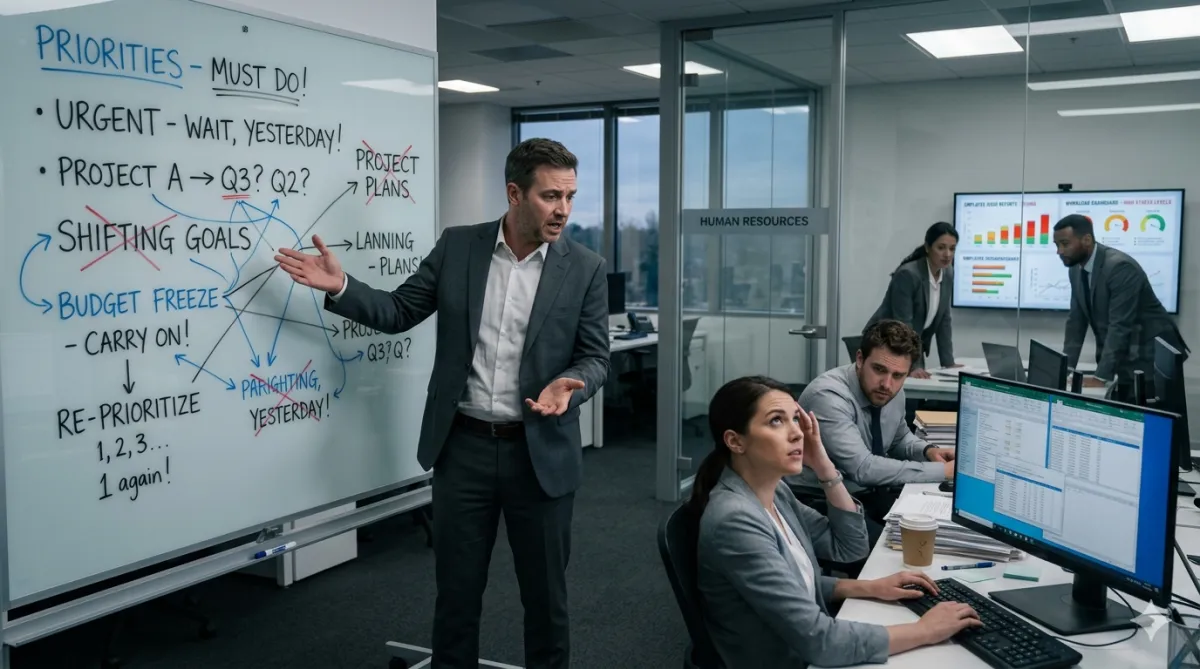
Your Managers May Be the Biggest Source of Organizational Strain
This Is the Part Most Organizations Don’t Want to Admit
When organizational strain increases, leaders often blame:
• workload
• market conditions
• employee expectations
• resource limitations
But those are rarely the root cause.
In many cases, the biggest source of strain is internal.
Manager behavior.
Managers Shape the Day-to-Day Reality
Strategy is set at the top.
But culture, performance, and execution are experienced at the manager level.
Managers control:
• how expectations are communicated
• how feedback is delivered
• how issues are handled
• how priorities are interpreted
• how teams operate under pressure
If that layer is inconsistent, everything downstream becomes unstable.
What Manager-Driven Strain Actually Looks Like
It shows up in patterns like:
• unclear or shifting expectations
• delayed or avoided feedback
• inconsistent communication across teams
• over-reliance on HR for basic issues
• lack of ownership over team performance
• reactive decision-making
• escalation of preventable problems
Individually, these seem manageable.
Together, they create constant friction.
Why This Becomes an HR Problem
When managers don’t operate consistently, HR absorbs the impact.
HR gets pulled into:
• conflict resolution
• performance correction
• communication breakdowns
• policy clarification
• employee dissatisfaction
Not because HR owns these issues.
But because managers aren’t resolving them at the source.
The Hidden Cost of Weak Manager Execution
Organizations often underestimate the impact.
But over time, it leads to:
• increased HR workload
• slower decision-making
• inconsistent employee experience
• reduced team performance
• higher turnover risk
• breakdown in trust
• misalignment across functions
And most importantly:
A constant state of operational strain.
Why Managers Struggle
This isn’t always a capability issue.
It’s often a system issue.
Managers are operating within environments where:
• expectations are unclear
• priorities are constantly shifting
• accountability is inconsistent
• leadership support is limited
• development is minimal
• performance standards are uneven
So behavior varies.
And that variation creates instability.
The Leadership Blind Spot
Executives often assume:
“Our managers are doing their job.”
But what they don’t see is:
• how often issues escalate unnecessarily
• how inconsistently teams are being led
• how much HR is compensating
• how much friction exists across teams
That gap between perception and reality creates risk.
What Strong Manager Performance Looks Like
In aligned organizations, managers:
• communicate expectations clearly
• address issues early
• provide consistent feedback
• own team performance
• reduce unnecessary escalations
• operate with clarity under pressure
That consistency reduces noise.
And when noise decreases, performance improves.
What Needs to Change
Organizations must stop treating manager performance as assumed.
It needs to be:
• clearly defined
• consistently reinforced
• actively developed
• measured through behavior, not just results
Because results can hide poor leadership.
But behavior reveals it.
The Shift That Matters
Instead of asking:
“How do we support our managers?”
Leaders must ask:
“How are our managers contributing to organizational strain?”
That question changes the focus from support → accountability.
The HR Reality
HR cannot reduce pressure if the source of that pressure remains unchanged.
And in many organizations, that source is:
inconsistent managerial behavior.
The Hard Truth
You cannot build a stable organization
on inconsistent leadership at the manager level.
The Question Leaders Must Ask
Not:
“Are our managers performing?”
But:
“How consistently are they leading?”
Because inconsistency is what creates pressure.
And pressure is what slows everything down.
Ready to Strengthen Your Workforce Strategy and Reduce HR Pressure?
Today’s HR leaders are being asked to do more than ever before: retain talent, improve culture, develop leaders, manage change, reduce operational strain, and prepare for the growing impact of AI.
But when HR is overloaded with constant employee escalations, leadership inconsistency, competing priorities, and reactive workflows, strategic progress slows.
You do not have to figure it all out alone.
BBRCM helps organizations reduce HR and leadership pressure, strengthen workforce strategy, improve organizational clarity, restore leadership accountability, and build healthier, future-ready HR systems.
BBRCM’s HR & Leadership Pressure Audit™ is designed to help organizations move from pressure to clarity to control, allowing HR teams and leadership to regain focus, reduce strain, and execute strategically.
Low lift on your team. High impact insights. Immediate relief.
Visit BBRCM LLC’s HR page to learn more about the HR & Leadership Pressure Audit™, pricing, and next steps:
https://bbrcmllc.com/hr
📧 Or email [email protected] to start the conversation.
