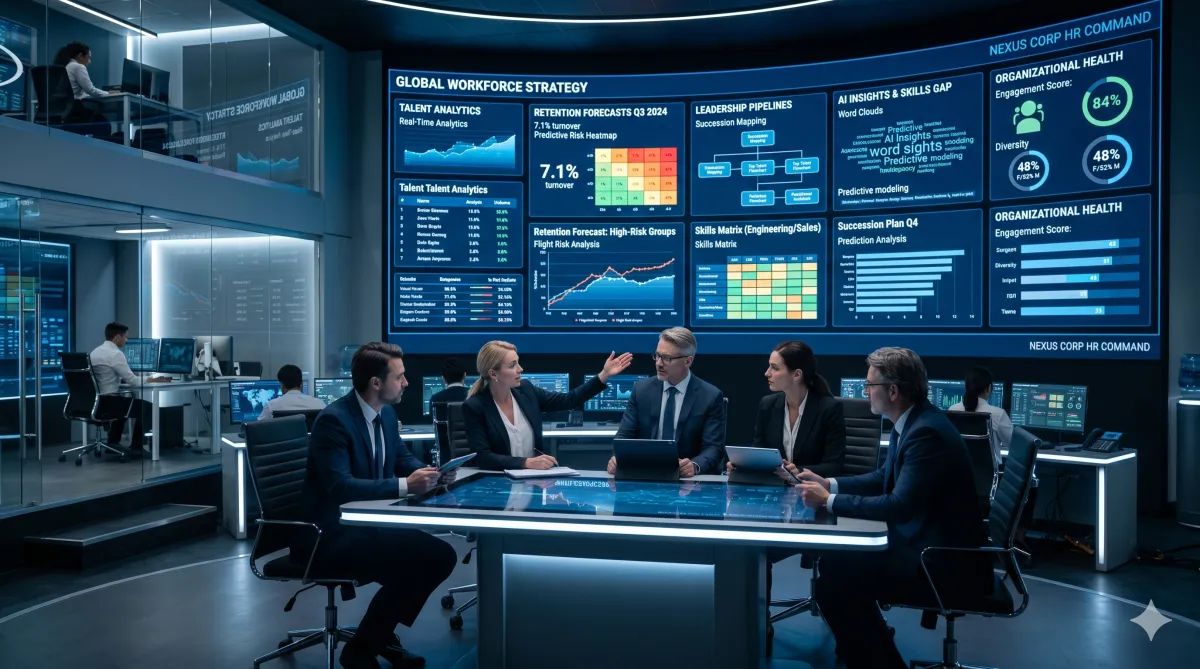
The Companies That Win the Next Decade Will Treat HR Like a Strategic Command Center
HR Is Still Being Undervalued in Most Organizations
In many companies, HR is still viewed as:
• administrative support
• compliance oversight
• employee relations
• policy management
Important—but not strategic.
That mindset is outdated.
Because in the next decade, workforce capability will determine competitive advantage.
And workforce capability is not built in operations or finance.
It’s designed—intentionally—through HR.
The Shift From Support Function to Command Center
A command center doesn’t just support activity.
It:
• monitors real-time performance
• identifies risk early
• aligns resources with strategy
• drives coordinated action
• influences critical decisions
That’s what HR must become.
Not reactive.
Not administrative.
But central to how the organization operates.
Why This Shift Is Happening Now
Three forces are accelerating the change:
1. AI Is Reshaping Work Faster Than Structures Can Adapt
Roles are evolving.
Skills are shifting.
Automation is changing execution.
Organizations need a function that can:
• redesign roles
• align skills to strategy
• manage capability gaps
That’s not optional anymore.
2. Leadership Gaps Are Becoming Business Risks
Many organizations have:
• weak leadership pipelines
• inconsistent decision-making
• limited readiness for complexity
These aren’t HR issues.
They’re strategic risks.
And they require intentional leadership development—not reactive fixes.
3. Culture Is Now a Performance Variable
Culture used to be treated as a “soft” factor.
Now it directly impacts:
• execution speed
• decision clarity
• team alignment
• retention of top talent
If culture is misaligned, performance breaks.
And HR is the only function positioned to influence it systemically.
What a Strategic HR Command Center Actually Does
It doesn’t focus on tasks.
It focuses on systems.
Workforce Capability Mapping
• What skills do we have?
• What skills are missing?
• What capabilities will we need next?
Leadership Pipeline Design
• Who is ready now?
• Who can be developed?
• Where are the gaps?
Organizational Alignment
• Are teams working toward the same priorities?
• Are decisions consistent across levels?
• Is strategy translating into execution?
Performance System Design
• Are expectations clear?
• Is accountability consistent?
• Are outcomes measurable?
Retention & Risk Monitoring
• Where are we losing key talent?
• Why are high performers disengaging?
• What patterns are emerging?
This is not HR as support.
This is HR as organizational control and direction.
The Cost of Not Evolving
Organizations that keep HR in a traditional role will face:
• misaligned workforce strategy
• slow adaptation to change
• leadership gaps that compound
• inconsistent execution
• increased attrition among top talent
• reduced ability to scale
And they won’t understand why performance is inconsistent.
The Organizations That Will Win
They will:
• integrate HR into strategic decision-making
• treat workforce planning as business planning
• invest in leadership development as infrastructure
• align culture with execution—not just values
• use data to guide workforce decisions
• design systems—not just manage people
They won’t ask HR to support strategy.
They’ll expect HR to shape it.
The Leadership Reality
This shift requires leaders to rethink:
• how they involve HR in decisions
• how they measure HR success
• how they define workforce strategy
• how they build leadership capability
Because if HR is not part of strategic conversations,
those conversations are incomplete.
The Professional Insight
For HR professionals, this is a turning point.
You are no longer expected to:
manage processes
enforce policies
support operations
You are expected to:
• influence business outcomes
• design workforce systems
• guide leadership capability
• align strategy with execution
That requires stepping into a more visible—and more accountable—role.
The Hard Truth
In the next decade, organizations won’t win because they have better products.
They’ll win because they have better-performing systems of people.
The Question Leaders Must Ask
Not:
“Is HR supporting the business?”
But:
“Is HR helping us build a workforce that can execute our strategy?”
Because if the answer is no,
your growth is already limited.
Ready to Strengthen Your Workforce Strategy?
Today’s HR leaders are being asked to do more than ever before—retain talent, improve culture, develop leaders, manage change, and prepare for the impact of AI.
You do not have to figure it all out alone.
BBRCM helps organizations build stronger leadership, smarter workforce strategies, healthier cultures, and HR systems that are ready for the future.
Visit BBRCM LLC’s HR page to learn more: https://bbrcmllc.com/hr
Or email [email protected] to start the conversation.
