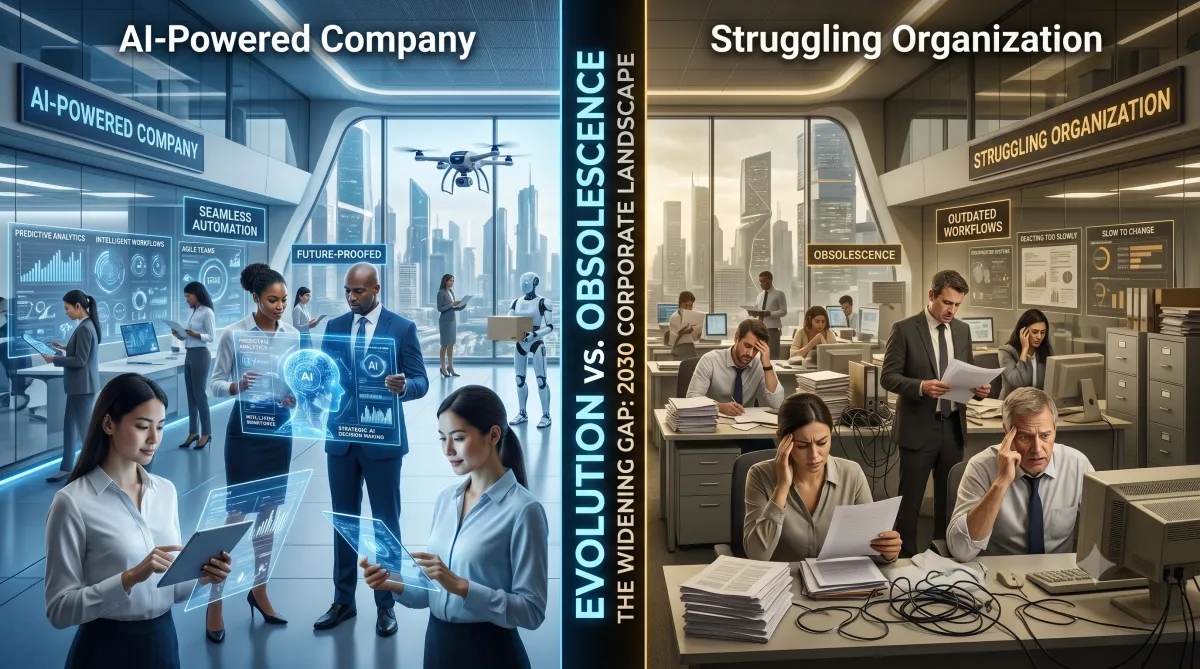
AI 2030 Will Divide Organizations Into Two Categories
AI 2030 Will Not Be a Minor Business Shift
Many organizations are still treating AI like a productivity tool, a short-term trend, a technology upgrade, and an operational enhancement.
But by 2030, AI will have fundamentally reshaped workforce structures, leadership expectations, operational execution, communication systems, decision-making models, and competitive advantage itself.
The companies preparing now will look very different from the companies reacting later.
The Divide Is Already Starting
Right now, organizations still appear relatively close in AI maturity.
But beneath the surface, a major separation is beginning to form.
By 2030, most organizations will likely fall into one of two categories.
Category 1:
Organizations that strategically evolved through leadership alignment, operational redesign, workforce transformation, AI governance, and structured adaptation.
Category 2:
Organizations still struggling with fragmented systems, reactive leadership, workforce instability, inconsistent AI usage, operational confusion, and delayed transformation.
The difference between these groups will not be small.
The Winning Organizations Will Not Just Use AI
They will redesign around it.
That means rethinking how work flows, how teams operate, how leadership functions, how decisions are made, how accountability is enforced, and how workforce strategy evolves.
Organizations that only automate tasks will fall behind organizations that redesign execution entirely.
AI 2030 Will Expose Leadership Capability Gaps
The next several years will demand leaders who can manage rapid transformation, operate with strategic clarity, align cross-functional teams, guide workforce adaptation, govern AI responsibly, and reduce operational friction.
Leaders who rely on outdated operating models will struggle to keep pace.
Because AI accelerates organizational exposure.
Workforce Expectations Will Shift Dramatically
By 2030, employees will expect AI integrated workflows, faster decision-making, smarter operational systems, clearer communication, modern leadership capability, and strategic adaptability from employers.
Organizations failing to evolve will increasingly struggle with retention, recruitment, workforce trust, and performance consistency.
The workforce will not wait for slow organizations to catch up.
HR Will Become More Strategic Than Ever
The future HR function will extend far beyond administration, compliance, and employee support.
HR will increasingly influence AI governance, workforce transformation, organizational redesign, leadership alignment, operational clarity, and workforce adaptability.
Organizations that fail to elevate HR strategically will create long-term instability.
AI Will Magnify Operational Weaknesses
One of the biggest misunderstandings about AI is the belief that technology automatically improves performance.
It doesn’t.
AI magnifies whatever already exists.
If organizations currently struggle with leadership inconsistency, communication breakdowns, workflow inefficiency, unclear accountability, and reactive operations, AI will accelerate those problems.
Faster systems make weak structures more visible.
Strategic Evolution Requires Difficult Decisions
The organizations that succeed by 2030 will likely redesign workflows aggressively, simplify operational structures, redefine workforce roles, invest heavily in leadership adaptability, align governance with innovation, and prioritize clarity over complexity.
This level of transformation requires intentional leadership.
Not reactive experimentation.
The Biggest Risk Is Thinking There Is More Time
Many organizations still believe:
“We’ll evolve when the market forces us to.”
But by the time pressure becomes unavoidable, competitors will already be ahead, workforce expectations will already shift, and operational gaps will already widen.
Late adaptation will become extremely expensive.
What Forward Thinking Organizations Are Doing Right Now
The companies preparing for AI 2030 are already aligning leadership teams, building governance structures, redesigning operational systems, preparing workforce transition plans, involving HR and Legal strategically, identifying pressure points early, and simplifying execution models.
They are not reacting to today’s AI.
They are preparing for the future operating environment AI will create.
The Hard Truth
By 2030, many organizations will not lose because they ignored AI.
They will lose because they failed to evolve around it strategically.
The Question Leaders Must Ask
Not:
“Are we using AI yet?”
But:
“Are we redesigning the organization fast enough to remain competitive in the AI era?”
Because the future advantage will belong to organizations that evolved before they were forced to.
Ready to Strengthen Your Workforce Strategy and Reduce HR Pressure?
Today’s HR leaders are being asked to do more than ever before: retain talent, improve culture, develop leaders, manage change, reduce operational strain, and prepare for the growing impact of AI.
But when HR is overloaded with constant employee escalations, leadership inconsistency, competing priorities, and reactive workflows, strategic progress slows.
You do not have to figure it all out alone.
BBRCM helps organizations reduce HR and leadership pressure, strengthen workforce strategy, improve organizational clarity, restore leadership accountability, and build healthier, future-ready HR systems.
BBRCM’s HR & Leadership Pressure Audit™ is designed to help organizations move from pressure to clarity to control, allowing HR teams and leadership to regain focus, reduce strain, and execute strategically.
Low lift on your team. High impact insights. Immediate relief.
Visit BBRCM LLC’s HR page to learn more about the HR & Leadership Pressure Audit™, pricing, and next steps:
https://bbrcmllc.com/hr
📧 Or email [email protected] to start the conversation.
